12/10~17 12/10 (6:00~8:00 pm)

年輕時做過許多的夢從畫家、警察到企業家走過了多少的辛酸歲月、歷經了許多人世的不平。終究還是回到自己最適合的一條路,不再屈服,不再委屈求全,只為了尋求自己夢中的天堂。
In my youth, I had many dreams—from becoming an artist, a police officer, to an entrepreneur. I went through countless hardships and witnessed much injustice in the world. In the end, I returned to the path that suits me best, no longer bowing down, no longer compromising. Now, I seek only to find the paradise of my dreams.

走過的路、流過的淚,一點一滴都累積在腦海,印記在自己的心靈,總會在適當的時間點悄悄的浮現、濕潤了雙眼,少了這些紀實無法豐富您的情感。我被記憶推著走,推向佛遠遙闊的天際。
The paths I’ve walked and the tears I’ve shed have accumulated bit by bit in my mind, leaving marks on my soul. They quietly resurface at the right moments, bringing tears to my eyes. Without these memories, my emotions would lack depth. I am carried forward by these memories, toward the vast, distant horizon of enlightenment.
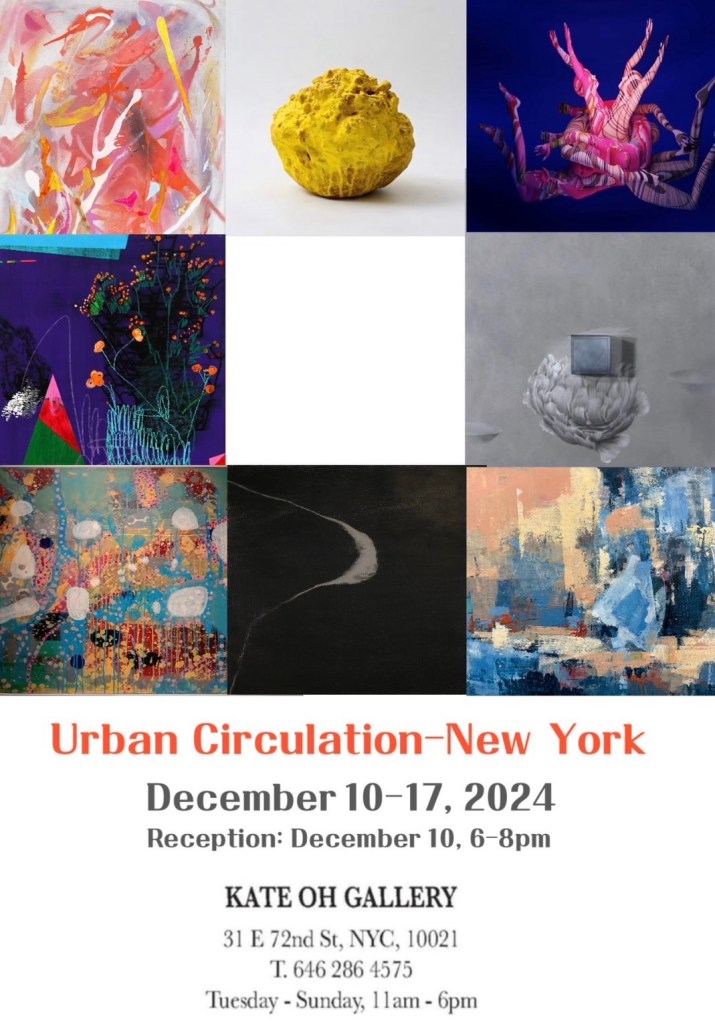
East Meets West on Madison Avenue: A Wave of Organic Post-Modernity at the Kate Oh Gallery
by Liu Xin
The Kate Oh Gallery brings together contemporary Asian painters who weave a rich tapestry of tradition and innovation, merging Eastern philosophies with Western abstraction in a dynamic hyperflow of cultural identities. It is like a crystal wave of creativity coming to the heart of NYC’s Upper Eastside.
Breaking ashore as if from a staggering ocean, it achieves more than a mere flotsam of contemporary Asian painters against Western waters—it becomes an organic post-modern tableau where the probabilistic nature of culture and identity unfolds. Just like liquid molecules themselves, the works on display are not static; they pulse with a dynamic interplay of tradition and innovation, evoking wave functions of artistic possibility that collapse into momentary certainties of aesthetic density.
The Organic Nature of Post-Modernity
At the heart of this exhibition is the question: What does it mean to bridge cultural worlds in an age of post-modernity? This question finds organic answers in the art’s forms, textures, and thematic resonances. The works are not rigid commentaries; instead, they feel alive, as though shaped by the currents of cultural memory and the imperatives of contemporary expression. The concept of organic post-modernity—an art that grows naturally out of the complex interplay of past and present—thrives here, particularly in the way these Asian painters reimagine their inherited traditions through a lens that feels both deeply personal and universally accessible.
The use of materials and techniques underscores the exquisiteness of this chemical solution. In some pieces, delicate ink washes recall classical Chinese painting, yet the subjects—vivid urban landscapes or abstract forms—belong to a globalized present. Elsewhere, bold applications of color and line evoke the gestural immediacy of Western abstract expressionism, yet the underlying compositional rigor speaks to an Eastern sensibility of balance and harmony. This fusion is not forced; it feels as natural as the growth of a vine, delineating exuberant roots and branches into something wholly new.
Probability Waves of Cultural Meaning
The exhibition resonates on another level, too: the quantum. Like probability waves in physics, these artworks are potentialities made manifest. Before encountering the viewer, each piece exists in a space of infinite meanings, shaped by the artist’s intentions, cultural context, and the viewer’s perceptions. When we look at a piece, we collapse its wave function—not into a single meaning, but into a personal resonance that feels as inevitable as it is unique.
This quantum metaphor is particularly apt for understanding how the artists navigate cultural duality. The oscillation between East and West is not a binary; it is a spectrum, a wave of probabilities. In one striking painting, a traditional Asian landscape dissolves into a riot of abstract brushstrokes, as if the artist were questioning the stability of any fixed identity. Is this a scene from the East, or the West? The answer, like a probability wave, depends on how we observe it.
Density as a Measure of Expressivity
The works in East Meets West on Madison Avenue also possess a density that transcends their materiality. Density here is not a matter of physical weight but of expressive content. Each canvas feels heavy with meaning, layered with references that range from the spiritual to the political. In one painting, the density comes from the meticulous accumulation of symbolic forms—dragons, cranes, and cherry blossoms—that seem to float in a sea of vibrant abstraction. In another, the density is emotional, conveyed through a single, bold stroke of red that cuts across the canvas like a wound.
This density reflects the artists’ ability to compress vast histories into finite spaces, much like poets distill epics into haikus. It also mirrors the cultural density of their experience as Asian artists engaging with Western audiences. The artworks are, in a sense, probability densities—maps of where the richest layers of meaning are likely to be found.
Creative Expressivity: A Bridge and a Wave
At its core, this exhibition is a celebration of creative expressivity. The artists are not simply bridging East and West; they are creating waves that ripple through both. Their works remind us that culture is not static but dynamic, a field of probabilities where new forms are constantly emerging. This creative expressivity is evident in the freedom with which they mix mediums, styles, and influences. A traditional ink painting technique might coexist with digital elements; a Zen-like minimalist composition might explode into a kaleidoscope of colors.
This fusion speaks to the deeper philosophical truth of the exhibition: that creativity is not about erasing boundaries but about transcending them. The artists do not deny their cultural origins, nor do they wholly adopt the styles of the West. Instead, they move fluidly between these worlds, like wave functions that are not bound to one state but exist in superposition.
Specific Artists
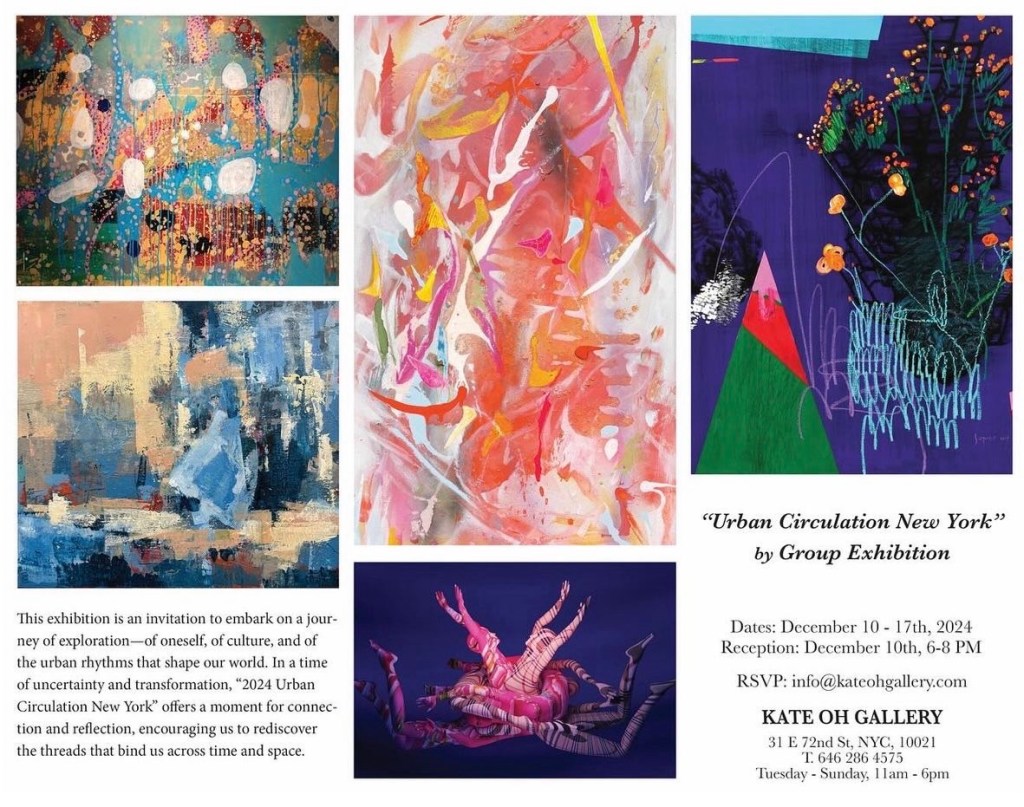
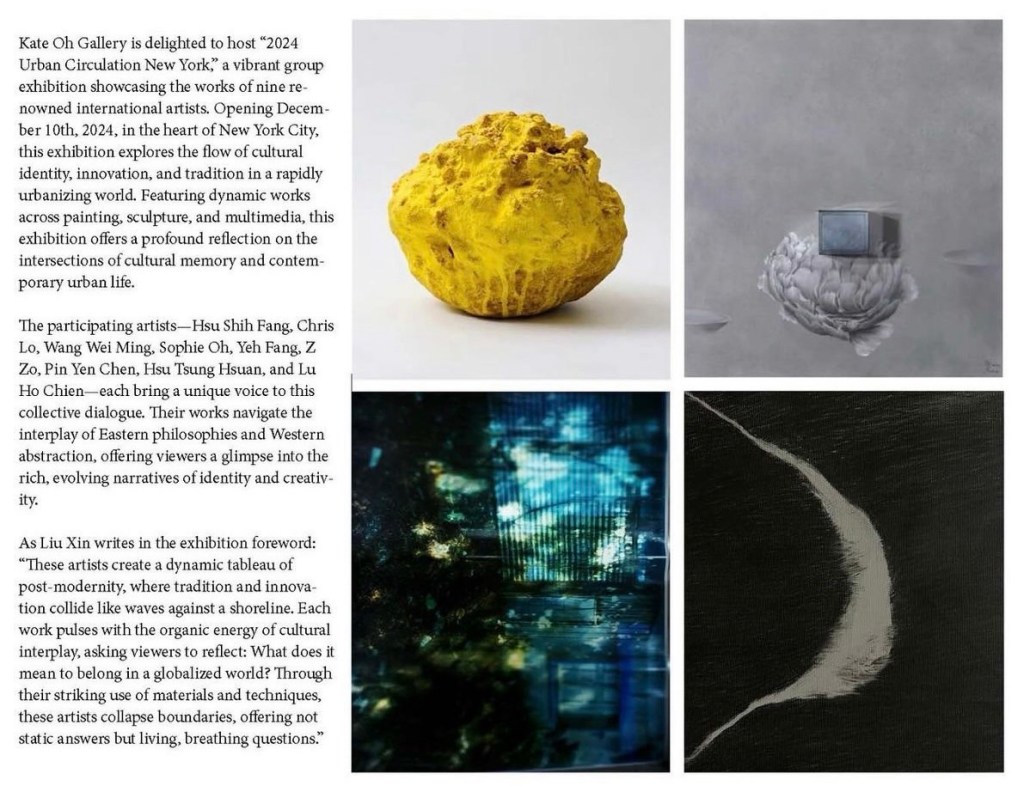
A few artists really stand out on this seashore of an exhibit, and their delectable waves of creativity are not to be missed. Works like Hsu Shih Fang’s meditative “A Repeated Viewing Respiration", Lu Ho Chien’s emotionally resonant “Imprints on the Soul", and Pin Yen Chen’s ethereal “Green Boundless" explore the organic evolution of identity and creativity, while Tsung Hsuan Hsu’s meticulous “Hidden Rivers of the World" and Sophie Oh’s experimental “Untitled" blur the boundaries of material and meaning. Wang Wei Ming’s provocative “Not About Fashion" critiques modern superficiality, and Yeh Fang’s vibrant “Dance Together-2″ celebrates movement and unity, all contributing to a collective wave of probability where tradition and modernity collide. Together, these works transform the gallery into a site of convergence—an organic post-modern landscape where art transcends binaries, inviting viewers into a shared exploration of creativity and cultural resonance.
麥迪遜大道上的東西相遇:凱特·吳畫廊的有機後現代浪潮
劉鑫 撰
凱特·吳畫廊匯集了當代亞洲畫家,他們以融合東方哲學與西方抽象的方式編織出傳統與創新的豐富圖景,在紐約上東區展現出文化身份的動態流動,如同創意的水晶波浪般湧向中心。
這場展覽宛如驚濤駭浪般衝上岸邊,不僅僅是一群當代亞洲畫家面對西方潮流的偶然漂流,更是一幅有機的後現代圖景,文化與身份的概率性特質在此展開。正如液體分子本身,這些作品並非靜態的,而是充滿了傳統與創新動態交織的脈動,激發出藝術可能性的波函,最終凝聚為瞬間的美學密度。
後現代性的有機本質
這次展覽的核心問題是:在後現代時代,如何跨越文化世界的界限?這個問題在藝術的形式、質地與主題共鳴中找到有機的答案。這些作品並非刻板的評論,而是仿佛帶著生命,由文化記憶的潮流與當代表達的需求所塑造。所謂有機後現代性——一種自然生成於過去與現在交織的藝術形式——在此蓬勃發展,特別是在這些亞洲畫家透過深刻個人化且普遍易於共鳴的視角重新想像其傳承傳統時。
作品中的材料與技法使用,凸顯出這種有機融合的精妙。在某些作品中,細膩的水墨畫法讓人聯想到傳統中國繪畫,但其題材——鮮明的城市景觀或抽象形式——則屬於全球化的現代。在其他作品中,大膽的色彩與線條運用喚起西方抽象表現主義的即時性,然而其深層的構圖嚴謹性又彰顯出東方對平衡與和諧的感知。這種融合並非刻意而為,而是如藤蔓般自然生長,展現出根與枝的蓬勃姿態,形成全然嶄新的事物。
文化意涵的概率波
展覽的另一層共鳴來自於量子視角。正如物理學中的概率波,這些藝術作品是可能性的具現。在觀眾欣賞之前,每件作品存在於無限意涵的空間,由藝術家的意圖、文化背景和觀眾的感知共同塑造。我們的觀看行為會使其波函坍縮——並非為單一的意義,而是成為一種個人的共鳴,既不可避免,又獨一無二。
這一量子隱喻對理解藝術家如何在文化二元性之間遊走尤其貼切。東方與西方的交替並非二元對立,而是一個光譜,一道可能性的波。在一幅令人印象深刻的畫作中,傳統的亞洲山水逐漸融解為一片抽象筆觸的狂歡,仿佛藝術家在質疑任何固定身份的穩定性。這是一個東方的場景,還是西方的?答案如同概率波,取決於我們如何觀察它。
表現密度的衡量
本次展覽中的作品還擁有一種超越其物質性的密度。這裡的密度不是指物理重量,而是表現內容的豐富程度。每幅畫布都蘊藏著深厚的意義,層層堆疊的參照從精神層面延伸至政治層面。在某些畫作中,密度來源於象徵性形式的精心積累——龍、鶴和櫻花似乎漂浮於一片充滿活力的抽象海洋中。在另一些畫作中,密度則是情感的,由一筆大膽的紅色筆觸傳遞,劃過畫布如同一道傷口。
這種密度反映出藝術家將龐大歷史壓縮進有限空間的能力,就像詩人將史詩濃縮為俳句一樣。這也映射出作為亞洲藝術家與西方觀眾對話時所經歷的文化密度。這些藝術作品在某種意義上是概率密度——指引我們發現最豐富意義層次的地圖。
創意表達:一座橋與一片波浪
展覽的核心是一場創意表達的盛會。藝術家們不僅僅是在搭建東西方之間的橋樑,更在兩者之間掀起漣漪。他們的作品提醒我們,文化不是靜止的,而是動態的,一個充滿可能性的場域,新形式不斷湧現。這種創意表達表現在他們混合媒材、風格和影響的自由之中。傳統的水墨技法可能與數位元素共存;禪意的極簡構圖可能爆發出萬花筒般的色彩。
這種融合揭示了一種更深層的哲學真理:創意不是消除界限,而是超越界限。藝術家們並未否認其文化根源,也未完全採用西方的風格。他們在這兩個世界之間自由流動,如同不受單一狀態束縛的波函,處於重疊之中。
突出的藝術家
展覽中有幾位藝術家的作品格外引人注目,其創意浪潮不可錯過。許詩芳的《反覆觀覽呼吸》帶有冥想氣息,呂和謙的《靈魂印記》情感深刻,而陳品妍的《綠色無垠》則充滿空靈之美。徐宗軒的《世界隱藏的河流》以精細技法見長,蘇菲·吳的《無題》則顯得實驗性十足。王威明的《與時尚無關》挑戰了現代的表面化,而葉芳的《共舞-2》則以鮮豔的色彩慶祝運動與團結。
這些作品共同塑造了一個匯聚之地——一片有機後現代的藝術景觀,在此藝術超越了二元對立,邀請觀眾共同探索創意與文化共鳴的奧秘。

 Sam
Sam 
發表留言